Tuesday, November 24, 2009

Leftoverture


Kansas/1976

Kansas: A progressive state of mind or band of wooly hayseeds? More about that later, but first a little musical history. When Progressive Rock initially reached our fair shores from its birthplace in England, this strange new sound confused and frightened the untamed (and badly dressed) natives, as they scratched their heads (among other parts of their bodies) in bewilderment. Songs that went on longer than three minutes? Time signatures going every which way but straight ahead in 4/4? Lyrics about crimson kings, giant hogweeds and total mass retain? Fancy-shmancy classical overtones?? Dude, pass me another GIQ and crank up some Grand Funk! After all, even in 1976 when Prog giants like Yes and Genesis had already established a strong foothold in the New World, most bands in middle America just wanted to boogie down and tie one on. Yet, the Prog muse mysteriously seeped into the very heartland, and took root in – of all places – Kansas. You know, the place where Dorothy and Toto (the dog, not the band) lived. Also residing in the state of Kansas was the band Kansas. With an excess of beards, mustaches and long, frizzy manes, one could easily mistake these guys for wooly mammoths in overalls. However, our furry farm boys could really play their instruments. And when not indulging their Grand Funk Railroad-wannabe tendencies, Kansas could throw down with the best of any snobby British Prog rockers. If the lads in Genesis had been born hauling hay bales and milking cows in the Midwest, they probably would have sounded like much of Leftoverture. Epics “Miracles out of Nowhere” and “Cheyenne Anthem” chug along in their unique, chamber-music-meets-cow-pasture classicism – complete with fiddly-twiddly organ/synthesizer workouts from Steve Walsh and beautiful violin playing from Robbie Steinhardt, whose flights of bowmanship meander in and out of these sophisticated arrangements like a honey-soaked bumblebee. The overplayed “Carry on My Wayward Son” all but consigned Kansas to AOR oldies purgatory, but nothing could prepare the mainstream rock audience weaned on that track for the monster closer “Magnum Opus.” Let’s just say you won’t be hearing this slightly over-the-top, nearly ten-minute-long multi-part symphony at your next barn dance. Looked upon derisively by critics, Kansas nonetheless reached high and went far, harvesting their bounty with several more successful albums through the end of the ‘70s – until a New Wave came crashing down on all things Prog. At their peak, several members of the band were even asked to appear on former Genesis guitarist Steve Hackett’s second solo album, Please Don’t Touch. Further evidence that these American farm boys could definitely hack it with the big boys.

Essential Tracks: “The Wall” “Miracles out of Nowhere” “Cheyenne Anthem” “Magnum Opus”

Saturday, November 21, 2009

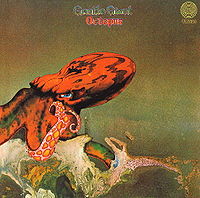
Octopus


Gentle Giant/1972

Once upon a time, kiddies, massive giants strode o’er the planet. These giants sang songs with strange and indecipherable lyrics that nobody could understand. They played exotic instruments like mellotrons, synthesizers, alto recorders and mandolins – making mysterious sounds that echoed across oceans and continents. One such giant was called, appropriately, Gentle Giant. Hailing from that land of the giants, England, the band’s music – at least to the ears of your basic let’s-boogie-down-and-get-hammered rock n’ roll audience – was an acquired taste (symbolically referenced in the title of their second album, Acquiring the Taste). Yet, to the burgeoning Progressive Rock crowd, seeking all things un-danceable, un-commercial and un-American, this British band was huge. If Gentle Giant was to maintain its cult status, it would be with this proud cult of obsessives. Although you probably won’t hear an album like Octopus at a wild party anytime soon (especially with a lead-off track titled “The Advent of Panurge”), the album is more streamlined and direct than their previous outings. Yet, it continues the standard Gentle Giant musical approach: insanely innovative and intricate (some would say hard to follow) arrangements, top-notch playing and vocal gymnastics that sound like a medieval men’s chorus. Tracks like “Panurge” and “A Cry for Everyone” come off almost as straight-ahead rockers – albeit uniquely warped Gentle Giant rockers. These tracks are punctuated with quirky interludes like the chamber orchestra violin arrangement on “Raconteur Troubadour” or the aforementioned vocal leapfrogging on “Knots.” A special note about the vocals…this is pretty much where the “acquired taste” part comes in. If a giant were actually straining to reach a high note, he might very well sound like vocalist Derek Shulman. His somewhat harsh, strident vocal approach is tempered, though, with keyboardist Kerry Minnear’s softer, more velvety voice on ballads like the pretty “Think of Me with Kindness.” Adorned in the UK with a cover by fantasy artist Roger Dean (the U.S. cover featured alternate art depicting an octopus in a jar) Octopus has assumed its rightful place as one of the genre’s classic albums, if not one of the strongest albums in the Gentle Giant canon. But even after 11 studio albums through 1980, the band was never able to scale the successful heights that fellow English Prog giants like Yes, Genesis, ELP and Pink Floyd reached – consigned to a destiny of musical obscurity, although this particular serving of Octopus is exceptionally flavorful once you've acquired the taste.

Essential Tracks: “Advent of Panurge” “Raconteur Troubadour” “A Cry for Everyone” “Think of Me with Kindness”

Monday, November 16, 2009

Turn Of The Cards


Renaissance/1974

How to describe the sound of Renaissance lead vocalist Annie Haslam’s voice? Hmmm, let’s see…remember that girl in the high school glee club who sang all the solos (not to mention leading the church choir on Sundays)? Perfectly hitting those high notes dead-nuts on, while mere mortals struggled, voices cracking in agony? You know, the girl who got straight A’s in every class. The one who always reminded the teacher to give the quiz that the teacher forgot about. Basically, you loved to hear her sing, but sometimes you just wanted to strangle the goodie-two-shoes (figuratively, of course). Now, take that crystal-clear, triple-octave voice, add a band with classical overtones (including classically trained pianist and band bedrock John Tout), what the hell, throw in a 30-piece orchestra or two. And there you have it: Renaissance. Launching this highbrow vibe with their third album, Turn of the Cards, Renaissance created what would be their musical MO – wrapping songs around long, orchestra-adorned arrangements that not only mirrored multi-movement classical pieces, but actually borrowed melody lines from a couple. While bands like Led Zeppelin paid homage to their blues hero Willie Dixon, Renaissance sounded like they’d been hanging out with Claude Debussy. However, with a player like John Tout in the band, we’re talking indisputable artistic legitimacy. This guy wasn’t just aping a classical player, he was the real deal. From the first notes of opening track “Running Hard,” Tout pounds the Steinway ivories like a mad maestro. No organs or synthesizers here. No electric guitars, either – that would be wrong for this tiny little orchestra. Tout is supported by bass guitar, acoustic guitar and drums. And of course, there’s Annie. Her crystalline voice shimmers throughout, performing tasteful vocal aeronautics that would make today’s overwrought “divas” cringe with shame and embarrassment. Epics like the opening track and the band’s signature piece, “Mother Russia,” swell and surge like good little classical pieces should, all the while showcasing that angel-on-high voice of Annie’s. No surprise that several years later, Renaissance played Carnegie Hall with the New York Philharmonic. Believe it or not, bands performing with orchestras were quite the rage back then – moving millions of albums, selling out prestigious concert halls. A time when golden-haired, flowing-gowned damsels warbled with heavenly voices, soaring over rolling piano arpeggios and melodic classical phrases. Was it rock n' roll? Not quite. A golden era? Perhaps…but without a doubt a true Renaissance period. (Ed. note: Review dedicated to Wayne!)

Essential Tracks: “Running Hard” “Things I Don’t Understand” “So Cold Is Being” “Mother Russia”

Friday, November 13, 2009

Nursery Cryme


Genesis/1971


No, your eyes are not deceiving you. That is, indeed, a young girl dressed in Victorian garb, playing croquet with the recently lopped-off heads of her playmates on the album cover. Such is the strange and enchanted world of Genesis, circa 1971. Think of it as a pleasant cup of English tea, spiked with just a dash of LSD. Nursery Cryme refers to the subject matter of the opening track, “The Musical Box,” where Cynthia lops off little Henry’s noggin, Henry later comes back as a ghost, then begins to age rapidly, but still wants to get laid. Okay, I guess you had to be there. But back in ’71, with Progressive Rock just starting to flex its creative muscle (or rear its ugly head, depending on your perspective), why not? With its classic lineup now firmly in place, thanks to the addition of Phil Collins on drums and Steve Hackett on guitar, Genesis was ready to unleash its warped, uniquely skewed take on all things English. Thus, we have the aforementioned lopping off of heads; giant hogweeds invading the English countryside; and nymphs from Greek mythology fluttering hither and yonder around the fountain of Salmacis. These flights of fantasy are all adorned with very intense music, performed by intelligent players who studied their instruments well, practicing in their bedrooms while all the other English kids were outside playing soccer. Not your typical rock band, the members of Genesis all seemed very smart, very polite, and would most likely prefer sipping a cup of tea by the fire over chugging a few pints at the pub. However, don’t mistake our gentle lads for wusses. When Hackett’s staccato, knife-piercing lead guitar lines aren’t shredding your brain in “The Return of the Giant Hogweed,” his crying, wailing-widow solos in “The Fountain of Salmacis” will bring you to tears. Collins plays like an over-caffeinated maniac (tea does contain caffeine, after all) throughout the album, although his drums are poorly recorded and buried in the mix (the bad production of this album is still a sore spot among fans ). With a foundation of lush, classically inspired orchestral keyboard shadings from Tony Banks, lead vocalist/eccentric Englishman Peter Gabriel puts these sordid tales of hogweeds and harlequins to vocal melody – using his best angel-with-a-2-pack-a-day-habit rasp. Actually their third album, Nursery Cryme was really the opening salvo in what would become the classic Genesis trilogy: Nursery Cryme, Foxtrot and Selling England by the Pound. Yet, even after committing these serious musical crymes in '71, it would take several more years before fans in the U.S. caught onto the act.

Essential Tracks: “The Musical Box” “The Return of the Giant Hogweed” “Seven Stones” “The Fountain of Salmacis”

Wednesday, November 11, 2009

Tales From Topographic Oceans


Yes/1974

Since we’re on the subject of concept albums…might as well haul out the mother of ‘em all, Tales from Topographic Oceans by Yes. First, let’s dispense with the usual puns associated with this album: they were in over their heads, adrift in a sea of pomposity, a band drowning in their own self-indulgence, etc., etc. A stunning artistic achievement or an orgiastic example of Prog excess? You be the judge. After a string of popular, pushing-the-musical-envelope albums including The Yes Album, Fragile and Close to the Edge, the band was on a roll and in peak form – the newly crowned kings of a fresh new genre that, believe it or not, was actually looked upon with approval by most rock critics at the time (even those notoriously anti-British writers at Rolling Stone). Upon completing their Close to the Edge tour in 1973, Yes hunkered down in the studio and embarked on a project to let it all hang out – immersing themselves in a concept based on the Shastric scriptures, from the book Autobiography of a Yogi by Paramahansa Yogananda. Not exactly a hip topic amongst your typically stoned, drunk-out-of-their-minds rock audiences back then. You can almost hear the collective “Huh??” This was heavy stuff, indeed, set to four album-side musical epics stretched over two pieces of vinyl (a double album), each slowly unfolding (some would say aimlessly meandering) like a long, lazy river of oblique lyrics, occasional mellotron passages, helped along by some killer guitar riffs from Steve Howe to prevent anyone from nodding off. Missing here were Bill Bruford’s laser-like, jazzy drum patterns (he left the previous year to join King Crimson), replaced by pounder Alan White’s more basic hammer-time style. These four massive pieces, with snappy titles like “The Revealing Science of God,” started off slowly, took their good ol’ time getting up to cruising speed, before finally (some would say mercifully) coming to an end. The usual Yes penchant for pristine harmonies, strong melodies, ingenious arrangements and expert musicianship was still there in full glory…provided you were extremely patient and had some time to kill. But when you make it to Side 3 and 4, there’s the uncomfortable feeling that ideas are running dry, with a little too much instrumental noodling here and tribal drum beating there – all, it seemed, just to fill up the obvious spare time and space. Monumental mistake or masterpiece? Then as now, opinions were intensely divided. Hardcore Yes fans launched their crusade to defend Topographic Oceans while fair-weather fans abandoned ship (and most likely never bought another Yes album). It’s hard to believe there was once an era in popular music when an album of this depth (sorry, couldn’t resist) and artistic audacity would actually be released by a major record company (Atlantic Records). Ah, the early '70s. What heady times they were – even though such risky musical expeditions could quite often become a voyage of the damned.

Essential Tracks: “The Revealing Science of God,” “The Remembering (High the Memory)”

Monday, November 9, 2009

The Concept Album


Good, Bad or Ugly?


A long time ago, in a musical universe far, far away, there lumbered a dinosaur (band) that strove to achieve artistic greatness and immortality. One way to attempt this glorious feat was to create a “concept album.” Basically, this meant wrapping the music and lyrics around an overall theme, connecting the various parts and movements within a whole framework consisting of a beginning, a middle and an ending. Back in the heady days of the late ‘60s and early ‘70s, it all made perfect sense. Whether you consider the very first concept album S. F. Sorrow by the Pretty Things, Tommy by the Who or Days of Future Passed by the Moody Blues, this lofty endeavor ultimately fell upon the earnest and enthusiastic Progressive Rock bands to pull off. Let’s face it, some concept albums worked and some didn't. A concept is merely a technique and doesn’t necessarily ensure artistic or commercial success. Some bands buckled under the heavy conceptual strain (Yes with Tales from Topographic Oceans; Genesis with The Lamb Lies Down on Broadway) while others reaped huge rewards and acclaim (the Who with Quadrophenia; Pink Floyd with The Wall). But whether or not you like the concept of a concept album, it still all comes down to the music. Great music can (and definitely has) existed within a bad concept (see Yes and Genesis above). Unfortunately, this grand approach opened up certain bands to the accusation of being “pompous” and “snooty” – words commonly leveled at Progressive Rock bands by their critics. Never mind that most of the musicians never considered themselves superior to the rest of humanity. Nor that their music was inherently better or smarter or deeper. In their minds, they were simply being creative and playing at their peak. The Prog guys just wanna have fun! And to be realistic, no specific musical genre has ever had exclusive rights to pomposity. Unless you're one of the few who have never experienced a pompous pop star, punk rocker, jazz musician, folk singer, etc. This misperception was created in large part by those who labeled the bands "progressive" in the first place. The word implies a superior attitude that was never really there. Unfortunately, once it became a label (and a genre), many misguided bands figured all they had to do was adopt a certain sound, use certain instruments, arrange music in a certain way, wear glittery capes...and voila! They would magically be transformed into a "progressive rock" band. Thus, many hacks came along and resorted to out-and-out mimicry. Which, in and of itself, is very unprogressive. Looking back, the glory days of the concept album now seem a quaint and distant echo of a time long passed. As does the very concept of an album itself – soon to be relegated to extinction in today’s iTunes digital download reality.

Saturday, November 7, 2009

U. K.


U. K./1978

The winds of change howled back in the late ‘70s. A major paradigm shift was slamming the glittery, glammy universe that was rock music. Younger and much poorer musicians were now looking upon the era’s wealthy celebrity rock stars (along with their “dinosaur” bands that came of age in the late ‘60s) with extreme disdain. Okay, hatred. These young musical revolutionaries – many of whom couldn’t even play an instrument, but had dead-on aim when spitting on members of their audience – would teach those old codgers a thing or two, and bring back the fire and passion they believed was lacking in rock music. Not exactly the best time to form a Progressive Rock super group, is it. Enter U.K., four battle-tested veterans from previous Prog giants: drummer Bill Bruford (King Crimson, Yes), bassist/vocalist John Wetton (Family, King Crimson), guitarist Alan Holdsworth (Soft Machine) and keyboardist/violinist Eddie Jobson (Curved Air, Roxy Music, Frank Zappa). Inhabiting an alternate universe that ignored the changing musical landscape, U. K. (the album) was a Prog lover’s wet dream, a final brief shining moment of ingeniously arranged, multi-part epics like “In the Dead of Night,” the sneaky, meandering instrumental “Alaska” and the jazz-meets-pomp of “Nevermore.” All played with extreme precision and dazzling instrumental interplay – stuff only guys who had been around the block a few times with their instruments could pull off. All four were obviously expert players in their own right. Problem was Bruford’s jazzy, scittering drum patterns and Holdsworth’s fluid fret work drifted further into jazz fusion territory, while Jobson’s twiddly, classical keyboard style and Wetton’s massive, distorted bass thud landed firmly in the heavy-duty Prog camp. In other words, it was all too good to last. After their debut album, U. K. split in two, with expatriates Bruford and Holdsworth forming another band (called Bruford) to more freely exercise their jazzier tendencies. Jobson and Wetton soldiered on with a new drummer, and U. K. was now a keyboard power trio – carrying the cross for a couple more albums before laying it down for good and moving on. The late ‘70s became the early ‘80s, MTV emerged on everyone’s 19-inch sets, and rock music evolved into big hair bands, synth-pop purveyors and futuristic new wavers. But, much like the title of the closing track on U. K., “Mental Medication,” these four musicians were the perfect prescription for an era on life support…before the plug was finally pulled on '70s Prog.

Essential Tracks: “In the Dead of Night” “Alaska” “Time to Kill” “Mental Medication”