Showing posts with label ELP. Show all posts

Thursday, April 1, 2010

Love Beach


Emerson, Lake & Palmer/1979

Let’s cut right to the chase: the album cover. Here we have Keith Emerson, Greg Lake and Carl Palmer. Three progressive rock gods. The first progressive rock super group. They stand amidst the tropical fauna, the sun romantically setting on the horizon. Dressed in shirts right out of the Saturday Night Fever wardrobe department, unbuttoned in front to show their manly, woolly chests. It’s as if the photographer said “Dudes, before you head out to the disco to pick up some chicks, let’s get a cover shot for the next album.” This one definitely belongs right up there in the What the Hell Were They Thinking Hall of Fame. Might as well nominate the album title, too, while we're at it. Love Beach? Really? Love Beach?? Let’s move on to the music. The first half of the album contains a selection of mostly short, radio-friendly (at least in their minds) tracks with such awe-inspiring song titles as “All I Want Is You,” “Taste of My Love” and “The Gambler.” Heard enough? These insipid little ditties – from the band that brought you prog masterpieces like “Take a Pebble,” “Tarkus” and “The Endless Enigma” – well, this stuff is just embarrassing and not really worth discussing. The second half of Love Beach at least makes a somewhat valiant attempt at respectability. A four-part song suite entitled “Memoirs of an Officer and a Gentleman” tells the story of a young English lad enlisting in the army to fight for crown and country. Granted, the concept is a bit over the top in its stuffy air of Victorian gallantry, but there are echoes of ELP greatness past: the melodic bombast of “Prologue: The Education of a Gentleman,” the classic Emerson grand piano flourishes in “Love at First Sight,” and the punchy synth riffs punctuating “Letters from the Front.” The final section, “Honourable Company (A March)” recalls previous ELP instrumentals “Aquatarkus” or “Abaddon’s Bolero” with Emerson building the arrangement around a catchy, repetitive main synth melody. One can almost visualize our honorable soldiers marching off into the sunset to this track…when, in reality, it was ELP marching into musical infamy. Love Beach received deservedly scathing reviews all around, got zero radio airplay (not surprisingly) and further fueled the argument of late-‘70s punks and new wavers that prog was a dead dinosaur. Also not surprising was the fact (to come out later) that Love Beach was merely a contractual obligation to Atlantic Records. ELP owed the label one more album, even though they were planning to call it quits. Which explains the “Let’s just go into the studio and get it over with so we can put an end to this fiasco” vibe of the entire project. Once the album was completed, the three band members then went their separate ways, slinking off into the island wilderness and signaling an end to a classic era…while leaving us with a musical document (and hilarious album cover) that would haunt them forever.

Essential tracks: “Memoirs of an Officer and a Gentleman”

Tuesday, March 2, 2010

Ars Longa Vita Brevis


The Nice/1968

In 1968, livin’ in the USA was getting a little crazy. Protests against the Vietnam War were raging. Rock music was evolving into a heavy, political mouthpiece of the counter culture. The original Pepsi generation was thumbing its nose at the straight-laced “establishment” of their parents. Long-haired musicians were smoking pot and getting high. It was a little different over in England. There, the musicians were getting high brow. Since there was no war to protest, things were a bit more mellow and sedate. While their American counterparts cranked up the amps to 11 for maximum distortion levels, the Brits were playing concertos and pleasantly mingling with orchestras. This musical dichotomy was perfectly symbolized by The Nice and their second album Ars Longa Vita Brevis. For starters, you could assume an album with an artsy fartsy title like that wouldn’t be one you’d hear at the next antiwar rally. The British philosophy was that rock music had now come of age, all grown up and perfectly capable of reinterpreting and reinvigorating the classics. And if any band was up to the task, it was The Nice. Based around the classical/jazz keyboard work of a young and extremely talented Keith Emerson, the album kicks off with the scorching instrumental tour de force “America” from West Side Story. Here, they ignite Leonard Bernstein’s score with Emerson’s purcussive Hammond organ playing the main theme, wrapped around guitarist Davy O’List’s propulsive power chords (O’List would depart the band after recording this one track.) To bolster their classical street cred, Emerson drops in snatches of Debussy’s "New World Symphony" for good measure. Evidently Bernstein himself was not amused by these young British upstarts messing with his tune. He was also annoyed after learning Emerson had set fire to an American flag during a recent performance of the piece. Legend has it that the boys ran into Bernstein at a New York recording studio, where one of the smart-alecky band members yelled out “Hey, Lenny, how’s it hangin’?” which probably did nothing to further endear them to Maestro Bernstein. Following this kick-Ars album opener, subsequent tracks like “Daddy, Where Did I Come From?” and “Happy Freuds” settle into a quirky, whimsical British psychedelia more reminiscent of the band’s debut album, The Thoughts of Emerlist Davjack, and definitely way out of step with the ’68 Zeitgeist of the USA. Things settle down and get more serious with a rather staid, low-key interpretation of Sibelius’ “Intermezzo from the Karelia Suite” based around Emerson’s lone keyboard, but lacking the fire and intensity of “America” (a killer live rendition of “Karelia” can be heard on the later album Five Bridges.) Which brings us to the main course of this album, the title track/concerto. Broken up into several sections with intimidating titles like “Prelude/First Movement – Awakening,” “Second Movement – Realisation” and “Coda – Extension to the Big Note” – and now complete with an actual orchestra – the extended piece doesn’t quite live up to the challenge. One major problem is the lack of a memorable main melody that weaves it all together, a recurring theme to guide the listener through these meandering movements of keyboard noodlings, orchestral climaxes and drum solos. Things perk up a bit with “Third Movement – Acceptance/Brandenburger,” where they borrow from Bach and bounce the jaunty melody off the orchestra. It’s one of the few moments where the rock band/orchestra partnership actually works well. But overall, this concerto inspires mostly droopy-eyed yawning. Though pointing the way to the progressive rock era yet to come, Ars Longa Vita Brevis was too over the top for restless American audiences of 1968. They wanted revolution, and not necessarily the musical kind. Not surprisingly, the album (with its distinctive neon-color X-ray album cover) sunk like a stone. The Nice would record several more albums, but it wouldn’t be until Emerson left the band and teamed up with Greg Lake and Carl Palmer that progressive rock (and Emerson’s career) would truly explode. On the original album sleeve, Emerson summed up the album and its title: “Tomorrow is yesterday's history and art will still be there, even if life terminates.” Ars Longa Vita Brevis is still here, but whether or not it’s truly art will long be debated.

Essential Tracks: “America” “Intermezzo from the Karelia Suite” “Third Movement – Brandenburger

Tuesday, February 16, 2010

The Watcher Observes From A Distance


Gabriel Bows Out of RRHOF Genesis Induction

To be snubbed or not to be snubbed. This is the conundrum facing the former members of Genesis, as they ponder the band’s upcoming induction into the Rock and Roll Hall of Fame – assuming their rightful position amongst recent or upcoming inductees/rock ‘n roll legends Abba, Madonna and The Dave Clark Five. Prog fans worldwide have groused over the years, complaining about the obvious lack of a progressive rock presence, as if bands like Genesis, King Crimson, Yes, ELP, etc., had never existed or didn’t really sell all those millions of albums and influence millions of musicians back in the glory days of 1969 through 1975. The Hall of Fame snub wasn’t really surprising, considering the American rock ‘n roll “intelligentsia” (if such a thing is even possible) led by Rolling Stone magazine founder Jann Wenner never really got Progressive Rock in the first place – thus, consigning it to illegitimate bastard/stepchild status among musical genres through predominantly negative reviews in his magazine. Until now. As Prog fanatics rejoice, merrily donning capes and prancing around their mellotrons in a fit of celebratory intoxication, there is still one snub yet to be snubbed. Seems former Genesis lead vocalist Peter Gabriel, lead singer – now a portly, white-haired and goateed gent – has decided to skip the induction ceremony, claiming he’s too busy planning his upcoming tour. For those not familiar with the history of Genesis, Gabriel left the band in 1975…a time when many claim the band had reached an artistic peak with their immense concept masterwork The Lamb Lies Down on Broadway. Gabriel then jumped ship, embarking on a long (and extremely slow-moving) yet highly respected solo career. This forced the band to morph, mutate and eventually become the polar opposite of its earlier quirky, groundbreaking, Gabriel-led incarnation – a slick, MTV-friendly ‘80s hit-making machine. Ironically, Gabriel himself scored a huge hit right around the same time with So…an album that itself contained several chart-topping hits. But along the way, Gabriel seems to have distanced himself from his old band mates. It's as if he’s protecting his artistic “street cred” by disassociating himself with the band he once fronted whilst donning bat wings, old man masks, and red dresses among other dramatic special effects – all to reinforce the unique fractured fairy tales put to classical rock music that Genesis had created in the early-‘70s. Now, nothing pisses of Prog fanatics more than an artist becoming an apologist for his former work…as if admitting, “Yeah, the critics were right and it was all just a bunch of crap back then…” Not that this is necessarily Gabriel’s intent with his Hall of Fame snub. When all is said and done, he was only with the band for about seven of its 20-something years of existence. And let’s face it – the casual fan on the street probably remembers Genesis more for Invisible Touch than for Nursery Cryme anyway. So, come time for the big induction ceremony, band mainstays Phil Collins, Tony Banks and Mike Rutherford will most likely be joined by former members/guitarists Anthony Phillips and Steve Hackett for the big bash. Prog will finally be represented in these hallowed halls, gaining at least some critical respect, albeit a bit late in the game…but respect nonetheless. Yet, the guy who really helped lead Genesis to its historic progressive heights – the singer whom most fans fondly remember as fronting Genesis at its legendary creative peak – is passing on the party. The 800-pound gorilla in the room, conspicuous by his absence. Seems the Watcher would prefer to observe these festivities from the sidelines.

2010 Rock and Roll Hall of Fame Inductees: ABBA, Genesis, Jimmy Cliff, The Hollies and The Stooges. Also being inducted this year as individual recipients of the Ahmet Ertegun Award will be David Geffen and songwriters Barry Mann, Cynthia Weil, Ellie Greenwich, Jeff Barry, Jesse Stone, Mort Shuman and Otis Blackwell. The ceremony will take place on March 15, 2010 at the Waldorf Astoria in New York City.

Tuesday, December 15, 2009

Tarkus


Emerson, Lake & Palmer/1971

Here’s a great idea for a Prog concept: the zany adventures of a creature called Tarkus – a cuddly little guy who’s part armadillo/part Panzer tank. We follow the mayhem that ensues, as our thickly armored mechanized mammal frolics along, flashing his two huge canons while engaging in fierce battle with a host of dastardly, nasty creatures. It’s all illustrated in sci-fi comic book fashion inside the gatefold album cover. Yes, Virginia, there really was a time when people would write rock music and lyrics around such wild and wacky stories. To the uninitiated, it would all seem rather geeky and…well, Trekkie-like, if not for one important aspect: the music. Based around a military-industrial-complex-strength keyboard riff by maestro/Hammond organ abuser Keith Emerson, “Tarkus” (the sidelong song suite) opens with a churning, grindingly unmelodic and impossible-to-whistle main theme that perfectly reflects the once-upon-a-blitzkrieg fairytale. Deviously skittering and scampering up and down the musical scale in god-knows-what time signature, this ominous, recurring keyboard theme (pummeled along by drummer Carl Palmer) is punctuated throughout by interludes of Greg Lake’s lovely, choirboy vocals on sections like the King Crimson-ish “Stones of Years,” and in the dark, ominous anti-war vibe that hangs over “Battlefield.” But it is Emerson’s keyboard gymnastics on organ, piano and Moog synthesizer that dominate “Tarkus” and exhilarate like no other keyboard player of the era could – punching, slapping, whacking, jabbing, fondling, hell, even stabbing his Hammond with knives (as he did when ELP performed live). If their 1970 debut album made people sit up from their late-‘60s stupor and take notice – with it’s popular “Lucky Man” single and Emerson’s manhandling of the Moog – then Tarkus (the album) would further cement the band’s reputation as one of the emerging Prog Rock leaders of the pack. Unfortunately, the tough-act-to-follow masterpiece that took up an entire side of vinyl consigned much of the material on Side 2 squarely in the let-down category. Aside from “Bitches Crystal” and “A Time and a Place,” both of which sound like they could have been outtakes from the first album, the remaining material tends to lack the electrifying intensity and focus of the “Tarkus” suite. It would be several more albums before ELP would achieve what many consider to be their ultimate masterwork, Brain Salad Surgery. Despite critical accusations of over-the-top bombast and in-your-face artistic indulgence (what some would argue ultimately brought down the band in the late ‘70s), it was ELP and their strange pet – an armed-to-the-teeth armadillo on tank treads – that initially made the world safe for the newly hatched musical genre called Prog Rock.

Essential Tracks: “Tarkus” “Bitches Crystal” “A Time and a Place”

Saturday, November 21, 2009

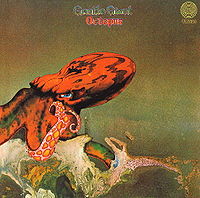
Octopus


Gentle Giant/1972

Once upon a time, kiddies, massive giants strode o’er the planet. These giants sang songs with strange and indecipherable lyrics that nobody could understand. They played exotic instruments like mellotrons, synthesizers, alto recorders and mandolins – making mysterious sounds that echoed across oceans and continents. One such giant was called, appropriately, Gentle Giant. Hailing from that land of the giants, England, the band’s music – at least to the ears of your basic let’s-boogie-down-and-get-hammered rock n’ roll audience – was an acquired taste (symbolically referenced in the title of their second album, Acquiring the Taste). Yet, to the burgeoning Progressive Rock crowd, seeking all things un-danceable, un-commercial and un-American, this British band was huge. If Gentle Giant was to maintain its cult status, it would be with this proud cult of obsessives. Although you probably won’t hear an album like Octopus at a wild party anytime soon (especially with a lead-off track titled “The Advent of Panurge”), the album is more streamlined and direct than their previous outings. Yet, it continues the standard Gentle Giant musical approach: insanely innovative and intricate (some would say hard to follow) arrangements, top-notch playing and vocal gymnastics that sound like a medieval men’s chorus. Tracks like “Panurge” and “A Cry for Everyone” come off almost as straight-ahead rockers – albeit uniquely warped Gentle Giant rockers. These tracks are punctuated with quirky interludes like the chamber orchestra violin arrangement on “Raconteur Troubadour” or the aforementioned vocal leapfrogging on “Knots.” A special note about the vocals…this is pretty much where the “acquired taste” part comes in. If a giant were actually straining to reach a high note, he might very well sound like vocalist Derek Shulman. His somewhat harsh, strident vocal approach is tempered, though, with keyboardist Kerry Minnear’s softer, more velvety voice on ballads like the pretty “Think of Me with Kindness.” Adorned in the UK with a cover by fantasy artist Roger Dean (the U.S. cover featured alternate art depicting an octopus in a jar) Octopus has assumed its rightful place as one of the genre’s classic albums, if not one of the strongest albums in the Gentle Giant canon. But even after 11 studio albums through 1980, the band was never able to scale the successful heights that fellow English Prog giants like Yes, Genesis, ELP and Pink Floyd reached – consigned to a destiny of musical obscurity, although this particular serving of Octopus is exceptionally flavorful once you've acquired the taste.

Essential Tracks: “Advent of Panurge” “Raconteur Troubadour” “A Cry for Everyone” “Think of Me with Kindness”